Design philosophy
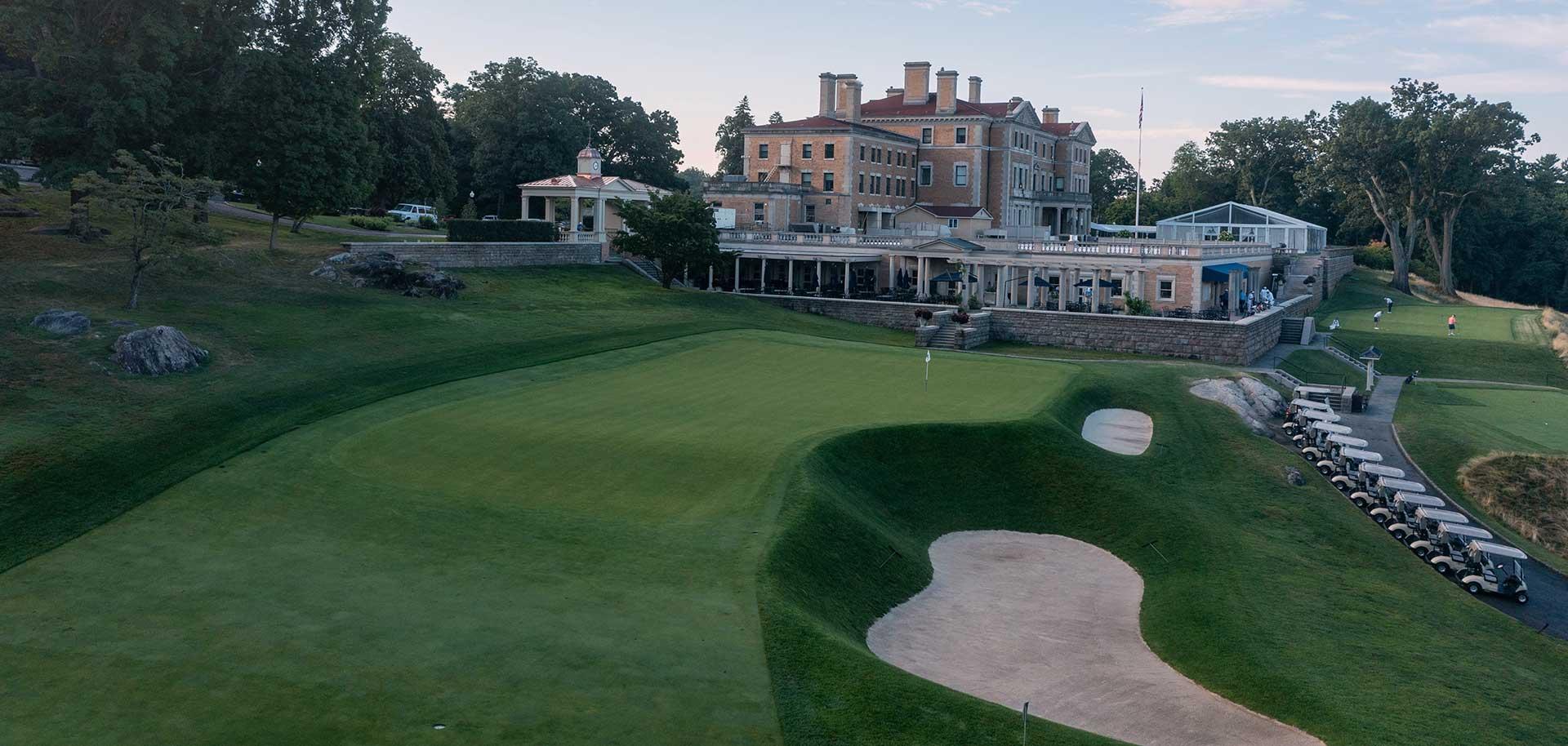
Reinterpreted templates; bold geometry; deep bunkers and compartmentalized greens; drainage engineering and readable strategy.
Seth Jagger Raynor was born at Manorville on Long Island on 7 May 1874. Unlike most leading architects of his period, he did not emerge from professional golf or greenkeeping. He studied civil engineering at Princeton and worked as a surveyor and engineer around Southampton at the eastern end of Long Island. That training gave him command of levels, drainage, site measurement and construction organisation. Raynor played little golf and never sought a competitive reputation; he understood the game chiefly through the geometry of land and by observing the strategic intention behind a hole. His career changed in 1908 when Charles Blair Macdonald hired him to survey the property for National Golf Links of America. Macdonald wanted to translate the principles of Britain’s finest holes onto American ground and found in Raynor an exceptional technical interpreter. The surveyor did far more than measure. He learned his client’s architectural vocabulary, supervised earthwork and converted historical ideas into buildable forms. He subsequently assisted Macdonald at Piping Rock, Sleepy Hollow, St Louis, Mid Ocean and elsewhere. Around 1914 Raynor began accepting commissions in his own name. In little more than a decade he produced or initiated dozens of courses, including Fishers Island, Shoreacres, Camargo, Mountain Lake, Yeamans Hall, Westhampton, Country Club of Charleston and Waialae. He also played a central role at Yale, one of the most monumental expressions of the Macdonald-Raynor school. His architecture employs hole families known as Redan, Biarritz, Eden, Road, Alps, Cape and Short, but these are not exact replicas. Raynor adjusted dimensions, orientation and the relationship between hazards and greens to each topography. Deep bunkers, legible geometry and sometimes dramatic platforms give his courses an immediately recognisable identity. Raynor’s strength is clarity. A hazard presents a distinct strategic question; greens are large enough to contain many hole locations, but their internal sections make angle of entry crucial. His engineer’s eye allowed him to intervene boldly on sites with limited natural expression while organising drainage and construction efficiently. Because he reused template concepts, his work was sometimes caricatured as repetitive. His best courses demonstrate the opposite: the same principle can produce a different experience when altered by wind, scale and landform. Raynor died suddenly of pneumonia at West Palm Beach on 23 January 1926, aged only fifty-one, with a full book of commissions. His associate Charles Banks completed several projects already under way. Long overshadowed by Macdonald, Raynor is now recognised as an author in his own right: the designer who converted a historical theory into a powerful, precise and adaptable spatial system.
Reinterpreted templates; bold geometry; deep bunkers and compartmentalized greens; drainage engineering and readable strategy.
Fishers Island; Shoreacres; Yale; Camargo; Mountain Lake; Yeamans Hall; Country Club of Charleston; Westhampton; Waialae; Mid Ocean (with C.B. Macdonald)
7 of 7 courses located — click a point to open its page.