Design philosophy
Grande maîtrise du terrassement et du shaping, paysages puissants mais site-specific, stratégie jouable à plusieurs niveaux et intégration croissante des contraintes environnementales.
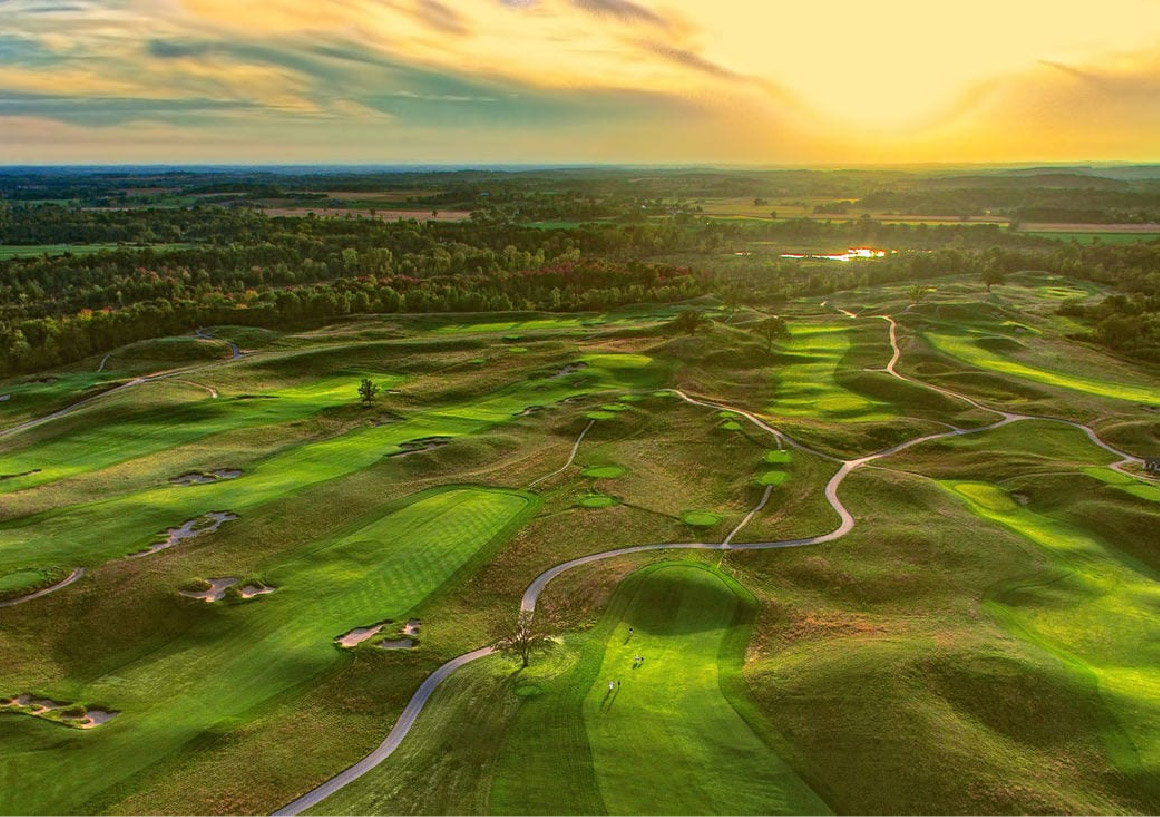
Dana Fry was born and raised in Kansas City, Missouri, and developed an impressive junior-golf record. From 1980 to 1983 he competed for the University of Arizona’s Division I men’s team. That playing background remains important to his design work: he visualises holes through trajectory, driving position and the sequence of decisions. At Tucson he recorded a course-record 64 at Randolph Park, while a period back in Kansas City produced a 62 at Minor Park. His entry into architecture came almost accidentally. During the summer before his final university year, Fry met Andy Banfield, a Tom Fazio associate, on the construction site at Ventana Canyon. Fry initially helped identify saguaro cacti for transplanting. The apparently modest task exposed him to the reality of course construction and determined his career. He then spent five years as a full-time shaper with Fazio, an on-site doctorate in earthmoving, machinery, volume and the way drawings evolve in soil. Fry joined Michael Hurdzan in 1988 and became a partner in 1997. Devil’s Pulpit, Devil’s Paintbrush, Naples National, Calusa Pines, Shelter Harbor and Erin Hills belong to their exceptional portfolio. At Erin Hills, journalist and architecture specialist Ron Whitten was also a co-designer. Hosting the 2017 U.S. Open confirmed Fry’s ability to work at immense scale without losing diversity among holes. In 2012 he formed Fry/Straka with Jason Straka. Arcadia Bluffs South, Union League National and international commissions demonstrate the firm’s development. Fry may employ major earthmoving when a site or programme requires it, as at Union League National, but the objective is a coherent landscape rather than mechanical spectacle alone. Graphic bunkering, legible landforms and options for several standards of player recur throughout the work. He has also pursued commissions in Asia, the Middle East and Europe while explicitly promoting sustainable development. A living architect, Fry remains fundamentally a field practitioner. His signature is less a repeated motif than the ability to understand soil, direct shaping and give each project an immediately individual personality. As no complete birth date is confirmed by a reliable public institutional source, none is invented.
Grande maîtrise du terrassement et du shaping, paysages puissants mais site-specific, stratégie jouable à plusieurs niveaux et intégration croissante des contraintes environnementales.
1 of 1 courses located — click a point to open its page.